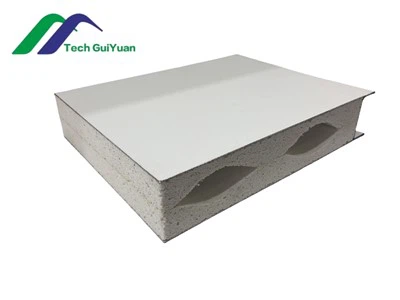
Industrial Polyurethane Partition Sandwich Panels are engineered composite elements consisting of dual metallic face sheets and a high-density rigid polyurethane (PUR) or polyisocyanurate (PIR) foam core. Manufactured via a continuous dual-belt lamination process, these panels deliver integrated thermal insulation, structural rigidity, and cleanability for controlled industrial environments.
Targeted at interior space division, pharmaceutical cleanrooms, food processing facilities, and cold storage compartments, the panel system eliminates secondary wall-building processes, reducing structural dead load and installation downtime.
Technical Specifications
|
Specification |
Details |
Test / Standard |
|
Core Material |
Rigid Polyurethane (PUR) / Polyisocyanurate (PIR) |
ASTM C591 / EN 13165 |
|
Core Density |
40 to 42 kg/m3 |
ISO 845 |
|
Standard Thickness |
50, 75, 100, 125, 150 mm |
ISO 2799 |
|
Standard Width |
950 mm, 1000 mm, 1150 mm (Modular) |
Production Tolerance |
|
Face Sheet Material |
Hot-dip galvanized steel, Galvalume, or Stainless Steel (304/316) |
ASTM A653 / EN 10346 |
|
Face Sheet Thickness |
0.4 mm to 0.8 mm |
Micrometer Measurement |
|
Thermal Conductivity (lambda) |
<= 0.022 W/(m·K) (Initial) |
EN 12667 / ASTM C518 |
|
Fire Performance |
PIR Core: B1 / B2 (DIN 4102), Class A (ASTM E84 optional) |
EN 13501-1 / FM 4880 (on request) |
|
Compressive Strength |
>= 150 kPa |
EN 826 |
|
Standard Length |
Up to 12,000 mm (Customizable for container shipping) |
Factory Tolerance Limit |
Key Features
Continuous Foam Adhesion: High-pressure injection and uniform foaming ensure a shear-resistant bond between the metallic skins and the PIR core, preventing core delamination under thermal cycling.
Thermal Efficiency: Closed-cell content exceeding 95% minimizes moisture ingress, maintaining stable thermal resistance (R-value) over long operational lifecycles.
Hygienic Surface Integrity: Smooth metallic facings paired with specialized coatings prevent microbial growth, withstanding frequent industrial washdowns and chemical sanitization agents.
Lightweight Structural Rigidity: High stiffness-to-weight ratio allows longer spans between intermediate structural supports, lowering primary steel framing requirements.
Applications & Project Typologies
Cleanrooms & Pharmaceuticals: Controlled environments requiring seamless flush joints, particle-free surfaces, and resistance to hydrogen peroxide (H2O2) and isopropyl alcohol (IPA) sterilization.
Cold Storage & Freezers: Temperature-controlled logistics hubs and food distribution centers requiring continuous thermal envelopes down to -40°C.
Food & Beverage Processing: Hygienic manufacturing floors demanding USDA/HACCP-compliant walls that resist organic acids, blood, and fat residue.
Industrial Warehousing & Plant Partitioning: Rapid space enclosure inside heavy manufacturing facilities, separating production zones from administrative or utility corridors.
Surface & Finish Options
Surface finish selection dictates chemical resistance and aesthetic integration within industrial facilities.
Coatings:
Polyester (PE): Standard interior applications with moderate humidity.
Polyvinylidene Fluoride (PVDF): Enhanced UV and chemical resistance for aggressive industrial atmospheres.
Food-Safe PVC/Plastisol: High film thickness (>100 um) for heavy-duty washdown zones.
Profiles:
Micro-ribbed: Increases panel rigidity while mitigating visual oil-canning.
Flat / Smooth: Standardized for cleanroom flush-joint integration.
V-Grooved: Provides architectural alignment lines for partition walls.
Standard Colors: RAL color chart matching (e.g., RAL 9002 Grey White, RAL 9010 Pure White). Custom corporate colors available upon minimum order quantity verification.
Customization Capabilities
Length Optimization: Panels cut precisely to project schedule dimensions to minimize on-site cutting waste.
Reinforced Embedments: Integration of internal timber or steel structural inserts during foaming to anchor HVAC ducts, electrical conduits, or heavy hanging loads.
Penetration Pre-cutting: Factory-routed openings for doors, pass-through boxes, fire dampers, and utility penetrations based on shop drawings.
Joint Integration: Specialized corner panels and T-junction profiles tailored for multi-room cleanroom layouts.
Manufacturing & Quality Control
Production Line: High-pressure continuous double-belt laminator equipped with multi-component mixing heads to guarantee precise chemical ratio distribution and density control.
Curing Control: Temperature-regulated curing ovens ensure complete cross-linking of the PIR/PUR matrix, eliminating post-production warping.
In-Line Quality Inspection:
Continuous ultrasonic monitoring: For void detection between core and steel facings.
Laser-based dimensional gauge verification: For panel thickness and squareness tolerances (+/- 1.0 mm).
Batch Traceability: Each production shift logs raw material batch numbers, foam index records, and peel-strength test results, accessible via factory quality documentation.
Installation & Joint System
Tongue-and-Groove Interlock: Precision-milled male and female edges ensure tight physical alignment and eliminate direct thermal bridging across the joint.
Fastening Method: Hidden fastener system utilizing self-tapping screws anchored to sub-framing, concealed within the male joint profile to maintain a clean exterior finish.
Air-Tight Sealing: Application of neutral-cure silicone or butyl sealant within the joint rebate during assembly to achieve air leakage rates below cleanroom specification thresholds.
Accessory Integration: Factory-matched aluminum extrusion flashings, base tracks, and corner caps ensure structural continuity at floor-to-wall and wall-to-ceiling intersections.
Packaging & Logistics
Protective Film: Strippable polyethylene protective film applied to both face sheets to prevent scratching during transit and handling.
Staking & Dunnage: Panels stacked on expanded polystyrene (EPS) blocks, separated by moisture-barrier interlayers, and secured with heavy-duty PET strapping.
Edge Protection: Edge protectors applied to all four corners of the bundle to prevent mechanical impact damage during forklift handling.
Container Loading: Engineered bundle sizing optimized for 20ft and 40ft high-cube open-top or standard dry containers, minimizing sea freight volumetric waste.
FAQ
Q: What is the primary difference between PUR and PIR cores for partition panels?
A: Standard PUR offers optimal thermal insulation for general warehouse partitions. PIR (Polyisocyanurate) features a modified chemical structure that provides superior fire retardation, char-layer formation, and compliance with strict building codes (such as B1 or FM approvals) required in regulated industrial zones.
Q: Can these partition panels support cantilevered loads like wall-mounted cabinets?
A: Standard foam cores possess limited direct screw-holding capacity for heavy concentrated loads. For wall-mounted equipment or service panels, we integrate internal plywood or steel plate reinforcements during manufacturing at designated anchor locations.
Q: What are the typical installation tolerances for length and squareness?
A: Panel length tolerance is controlled within +/- 2.0 mm for lengths under 6m, and squareness deviation is kept under 1.5 mm, ensuring tight structural alignment without on-site trimming.
Q: How are panel joints sealed in high-hygiene cleanroom environments?
A: Joints are assembled with a tongue-and-groove profile combined with an anti-microbial, FDA-compliant silicone sealant bead applied in the reveal, preventing particle entrapment and bacterial proliferation.
Q: What documentation is provided for structural and fire compliance?
A: We supply comprehensive technical dossiers including EN/ASTM laboratory test reports, thermal conductivity certificates, raw material safety data sheets (MSDS), and project-specific shop drawing take-offs.
Hot Tags: industrial polyurethane partition sandwich panels, China industrial polyurethane partition sandwich panels manufacturers, suppliers, factory