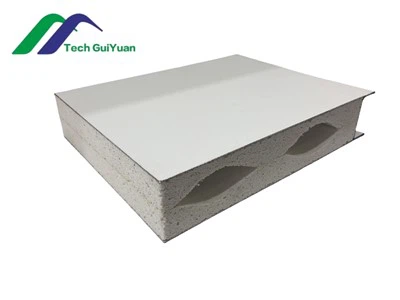
Warehouse Polyurethane Partition Sandwich Panels are factory-engineered composite elements consisting of a rigid closed-cell polyurethane (PUR) or polyisocyanurate (PIR) foam core bonded between two structural steel facings. Designed specifically for internal industrial space division, these modular panels establish clean, thermally efficient, and structurally stable partition walls without requiring wet trades or secondary structural framework.
Engineered to replace traditional stud-and-drywall or block masonry assemblies, these self-supporting panels shorten installation schedules, lower dead loads on industrial mezzanines, and meet strict compartmentalization codes in distribution hubs and fulfillment centers.
Technical Specifications
|
Specification |
Standard / Available Options |
|
Panel Thickness |
50mm, 75mm, 100mm | Alternative: 120mm, 150mm (upon structural engineering request) |
|
Standard Module Width |
1000mm / 1150mm | Alternative: Custom widths manufactured for tight layout modules |
|
Facing Material |
Hot-dipped galvanized steel (0.4mm – 0.6mm) | Alternative: Stainless steel (304/316), Al-Zn alloy coated steel |
|
Core Material |
Rigid Polyurethane (PUR) / Polyisocyanurate (PIR) | Alternative: FM-approved PIR core |
|
Core Density |
40 +/- 2 kg/m3 | Alternative: High-density structural option (42–45 kg/m3) |
|
Thermal Conductivity (lambda) |
<= 0.022 W/(m*K) | Alternative: Laboratory tested at 10 deg C mean temperature |
|
Fire Behavior Classification |
B2 (GB 8624) / Class B-s1, d0 (EN 13501-1) | Alternative: PIR core achieving FM Class 1 (FM 4880) |
|
Joint Configuration |
Tongue-and-groove with concealed fastener option | Alternative: Cam-lock modular joint for cleanrooms and cold storage |
Key Features
High Thermal Resistance: Closed-cell content exceeding 95 percent restricts heat transfer, stabilizing internal microclimates and minimizing HVAC energy consumption across partitioned zones.
Self-Supporting Spans: High flexural strength allows extended vertical spans between structural supports, reducing the need for secondary steel girts.
Airtight Interlock: Precision-milled tongue-and-groove profiles prevent air and vapor leakage, satisfying differential pressure requirements in controlled spaces.
Rapid Dry Construction: Factory-cut dimensions and interlocking edges eliminate curing delays, cutting installation labor hours by up to 50 percent compared to masonry.
Sanitary Surface Integrity: Non-porous metallic facings resist dust, moisture, and chemical washdown routines.
Applications
Logistics and Distribution Centers: Compartmentalizing dry storage zones from sorting bays, offices, or multi-tier mezzanine levels.
Cold Chain and Food Processing: Constructing temperature-controlled holding rooms, staging areas, and processing partitions (0 deg C to +15 deg C).
Cleanrooms and Pharmaceutical Labs: Forming airtight modular partitions meeting strict particle-control and chemical resistance standards.
Industrial Enclosures: Creating secure inventory cages, equipment enclosures, and employee breakrooms within large manufacturing plants.
Surface and Finish Options
Metallic Facings:
Standard Polyester (PE): 20–25 micron coating delivering standard corrosion resistance for typical warehouse environments.
Fluoropolymer (PVDF): Superior UV and chemical resistance tailored for facilities exposed to aggressive cleaning agents or exterior sunlight.
Food-Grade PVC / Plastisol: 100–120 micron textured finishes designed for food safety compliance and frequent washdowns.
Profile Options:
Micro-Ribbed: Minimizes visual oil-canning over long spans, maintaining a clean, uniform industrial appearance.
Flat / Plain: Smooth surface optimized for sanitary cleanroom wiping and seamless joint sealing.
Lightly Fluted: Enhances structural rigidity for taller partition elevations.
Customization Capabilities
Exact-Length Production: Panels cut to precise millimeter site dimensions, eliminating on-site cutting waste and raw edge corrosion.
Pre-Engineered Cutouts: Factory routing for pass-through doors, vision panels, HVAC ducting, and electrical utility chases.
Embedded Structural Inserts: Internal steel backing plates integrated into the foam core to support heavy hanging loads, utility pipes, or cantilevered brackets.
Custom RAL Color Matching: Available for corporate branding or specific architectural specifications.
Manufacturing and Quality Control
Continuous Double-Belt Lamination: High-pressure automated foam injection combined with a heated double-belt press ensures uniform foam density, zero interior voids, and permanent chemical adhesion between steel skins and the PUR core.
Automated Tolerance Control: CNC laser-guided saws maintain length tolerances within +/- 2 mm and diagonal squareness within +/- 1.5 mm.
Rigid Testing Protocols: Compressive and tensile strength verification per production shift; peel adhesion testing to guarantee core-to-steel bond strength; independent third-party laboratory test summaries available for fire ratings and thermal values.
Installation and Joint System
Deep Tongue-and-Groove Interlock: Interlocking profile design self-centers adjacent panels and eliminates direct thermal bridging.
Fastening Method: Concealed fixing clips or structural self-tapping screws anchored directly into floor/ceiling tracks and structural steel columns.
Airtight Joint Sealing: Factory-applied butyl sealant or neutral-cure silicone beads injected within the joint groove to establish moisture and air barriers.
Complete Trim Package: Supplied with project-specific base U-tracks, top channels, internal/external corner flashings, and fasteners.
Packaging and Logistics
Surface Protection: Non-abrasive, peel-away polyethylene protective film applied to both steel faces to prevent scratching during shipping and handling.
Secure Bundling: Panels stacked on expanded polystyrene (EPS) support blocks, bound with heavy-duty composite strapping, and wrapped in weather-resistant woven HDPE film.
Container Optimization: Bundles configured for standard 20ft and 40ft high-cube containers or flatbed transport, optimized for safe forklift side-loading and jobsite rigging.
FAQ
Q: What is the maximum unsupported height for these warehouse partition panels?
A: Depending on the panel thickness (e.g., 100mm) and local wind or pressure differentials, maximum vertical spans typically range from 4.0 to 6.0 meters without intermediate structural steel support. Contact our engineering team for project-specific span tables.
Q: Do these panels comply with building insurance standards for fire performance?
A: Standard warehouse partitions utilize a B2 fire-retardant PUR core. For projects governed by strict insurance regulations (such as FM Global guidelines), we offer FM 4880 certified PIR core panels. Certified classification reports are available upon engineering request.
Q: Can electrical and plumbing utilities be routed through the partitions?
A: Yes. Pre-planned vertical or horizontal conduit chases can be incorporated during manufacturing, or surface raceways can be fastened directly to the steel facings. Internal reinforcement plates can also be embedded at designated heights.
Q: How are the panels anchored to the building structure?
A: Installation is executed using heavy-duty galvanized floor tracks anchored to concrete slabs, matched with top receiver tracks secured to structural steel or purlins. Panels sequence-lock into the tracks for rigid alignment.
Hot Tags: warehouse polyurethane partition sandwich panels, China warehouse polyurethane partition sandwich panels manufacturers, suppliers, factory